Books by Eric Douglas

Thriller fiction and Non-fiction

  • Home
  • Mike Scott Thrillers
    • Explosion: Down Below
    • Held Hostage: Search for the Juncal
    • Water Crisis: Day Zero
    • Turks and Chaos: Hostile Waters
    • The 3rd Key: Sharks in the Water
    • Oil and Water: Crash in Curacao
    • Return to Cayman: Paradise Held Hostage
    • Heart of the Maya: Murder for the Gods
    • Wreck of the Huron: Cuban Secrets
    • Guardians’ Keep: Mystery below the Adriatic
    • Flooding Hollywood: Fanatics at the Dam
    • Cayman Cowboys: Reefs Under Pressure
  • Withrow Key
    • Lyin’ Fish
    • Tales from Withrow Key
  • Agent AJ West
  • About the Author
    • Publicity and Interviews
  • Nonfiction
    • For Cheap Lobster
    • Heart Survivor: Recovery After Heart Surgery
    • Oral History
      • Batter Up!
      • Memories of the Valley
      • WV Voices of War / Common Valor
      • Capturing Memories: How to Record Oral Histories
    • Dive-abled: The Leo Morales Story
    • Keep on, Keepin’ On: A Breast Cancer Story
    • WV Voices of War / Common Valor
    • Russia: The New Age
    • Scuba Diving Safety
  • Free Short Fiction
  • Other Fiction
    • Sea Turtle Rescue and Other Stories
    • River Town
You are here: Home / Documentary / History in a cemetery

History in a cemetery

April 3, 2012 By Eric Douglas

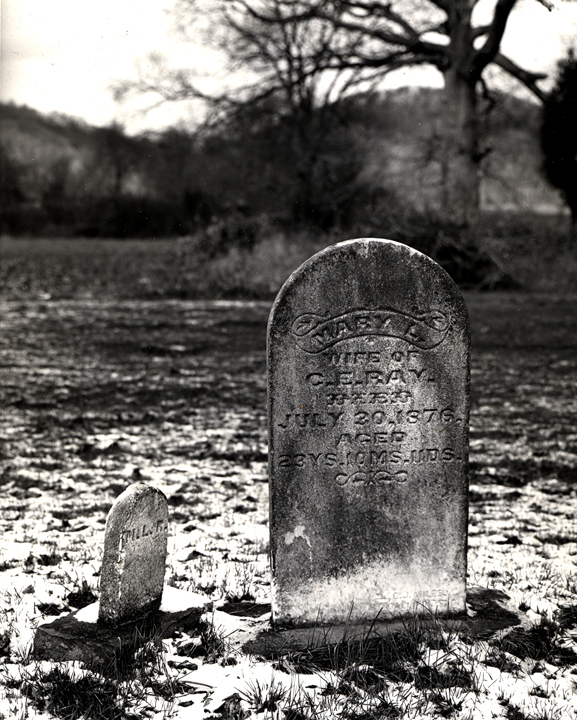
I’ve always been fascinated with old cemeteries. Obviously, they are places of sorrow and grief along-side honor and remembrance. But they are also incredibly historical. I still remember a photograph I took 20 years ago in Buffalo, West Virginia. It was a small family cemetery with a light covering of snow on the ground. There were two headstones together; one of a mother and one of an infant. The mother died “aged 23 years, 10 months and 11 days.” She probably died in childbirth with her baby.

Sometimes it’s hard to grasp “history”…especially things that happened 200 years ago in places you’ve never been. At that point, it’s about words on a page rather than people and lives and human events. But when you visit a cemetery and see a grave from someone who lived through an event, or even died during that event, it seems to become more real. Since my daughters are hanging out with me this week for spring break, I thought I would show them what they could learn.
There is a small family cemetery just up the road from where I live. I’d never stopped there, but I was sure just from the look of it that we would find something interesting. A man was cutting the grass when we arrived. He said his father had cut the grass for years and when he got too old to keep it up, the man took over the job himself. His grandparents were buried there, along with his great, great grandfather who fought with the 4thWest Virginia regiment in the Civil War. And there was the connection I was looking for.
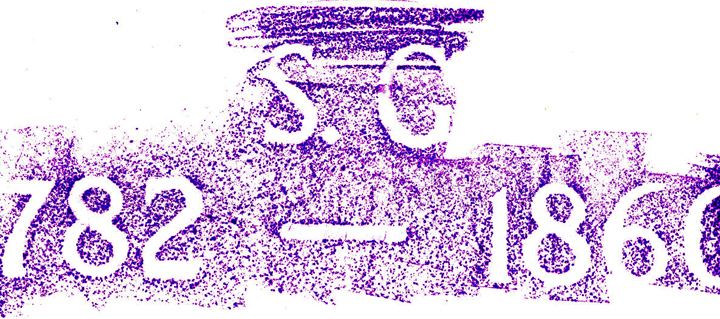
I showed the girls how to make rubbings of the headstones to possibly find details that you couldn’t see clearly. We ended up making a rubbing of the headstone for the man’s ancestor and we gave it to him to take home with him. He showed us the oldest grave in the cemetery, too. SG Jarrett was born in 1782 and died in 1860. Think about those years. That was the formation of our nation between the Revolutionary War and the Civil War.
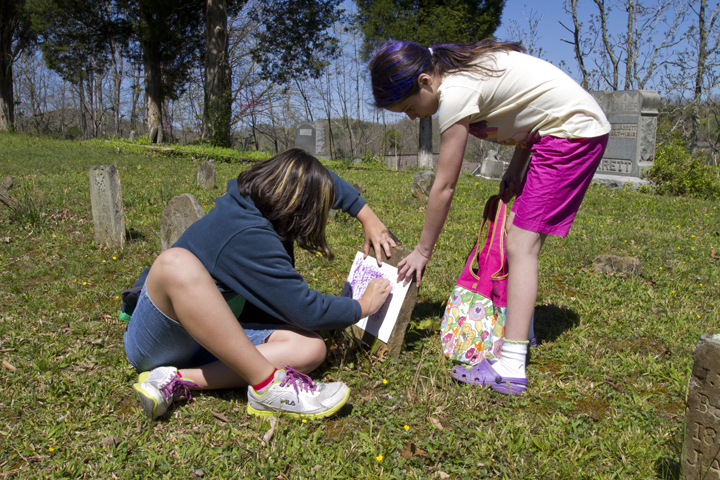
Our friend also told us that there were some slaves buried near the front of the cemetery. He wasn’t sure of it, but that was local history. That got a “cool” from one of the girls. Not a “cool” for slavery, obviously, but a cool that that sort of history existed right there. They stopped to look at the small, un-etched grave markers. At each spot, there was only a small block of stone to record a life. They seemed to realize that it wasn’t “just” or “fair” that some people got large, family markers while slaves got little more than a rock indicating where their head would lie for eternity.
History isn’t always huge monuments in the nation’s capitol. But there is history in our very own backyards as well. In this one cemetery, in about a half an hour, we found a man who fought in the Civil War, graves of slaves, and someone who lived even before that, when the very first settlers came to this part of the world.  It never hurts when you can make a connection through a person as well.

.

Filed Under: Documentary

Now Available!

Photojournalist Mike Scott is about to get married to the woman he loves — archeologist Frankie DeMarco – but her kidnapping sets Mike on a collision course with the treasure hunter who took her. The man wants Frankie’s help finding a 400-year-old shipwreck so Mike sets out to find it first to get her back […]

View Book

Spooky Flash Fiction For Advent 2025

December 18, 2025 By Eric Douglas

In the 1963 Andy Williams song, “It’s the Most Wonderful Time of the Year,” there is a line that says “There’ll be scary ghost stories, And tales of the glories of Christmases long, long ago.”

Take a flight in a biplane!

https://youtu.be/WN8BrcSNel0
https://youtu.be/lFWWbTXrTJQ?si=SJAadKSt9ZLCbOvX

How I got into diving!

https://youtu.be/gKhw-4tORAM

Heart Blog

Heart Survivor Book Proceeds to Heart Walk

Charleston author Eric Douglas will donate proceeds from his book Heart Survivor: Recovery After Heart Surgery to the 2017 Charleston Heart Walk. Douglas wrote the book to detail his recovery from open-heart surgery and his return to fitness to inspire others facing the same diagnosis. In January 2016, Douglas visited his doctor to rule out the […]

More Posts from this Category

Heart Blog
  • Heart Survivor Book Proceeds to Heart Walk
    Charleston author Eric Douglas will donate proceeds from his book Heart Survivor: Recovery After Heart Surgery to the 2017 Charleston Heart Walk. Douglas wrote the book to detail his recovery from open-heart surgery and his return to fitness to inspire others ...
  • Introduction to the book Heart Survivor
    The following is most of Chapter 2 from the book Heart Survivor. I thought it was important to help my readers understand that I should have recognized the signs and symptoms of impending heart issues, but even with that experience, ...
Read more

Return to Cayman book trailer

Sunlight Prints

Cyanotype printing, also known as Sunlight Prints, is an antique photo printing technique, first used around 1842. Cyanotypes are made by mixing two chemicals (ammonium iron citrate and potassium ferricyanide) and treating paper, cloth or canvas, making it sensitive to ultraviolet light. The sun turns the chemical blue while whatever is shaded stays white. One of the earliest uses for cyanotype was for naturalists to capture images of plants. The same process is used to create “blue prints” of … Read more

The Buzz

You want to explore the ocean, alongside Mike Scott! -- Rosemary E Lunn Diving Journalist and Scuba Industry Fixer
Land Sharks cover
  • Facebook
  • Instagram
  • LinkedIn
  • Substack
  • Threads
  • YouTube

Privacy Policy


NO AI POLICY: Eric Douglas/BooksbyEric does not use artificial intelligence tools to generate, draft, edit, or automate our core work—including writing, artwork or photography. Everything we produce is created by humans.

Copyright © 2026 ·