Books by Eric Douglas

Thriller fiction and Non-fiction

  • Home
  • Mike Scott Thrillers
    • Explosion: Down Below
    • Held Hostage: Search for the Juncal
    • Water Crisis: Day Zero
    • Turks and Chaos: Hostile Waters
    • The 3rd Key: Sharks in the Water
    • Oil and Water: Crash in Curacao
    • Return to Cayman: Paradise Held Hostage
    • Heart of the Maya: Murder for the Gods
    • Wreck of the Huron: Cuban Secrets
    • Guardians’ Keep: Mystery below the Adriatic
    • Flooding Hollywood: Fanatics at the Dam
    • Cayman Cowboys: Reefs Under Pressure
  • Withrow Key
    • Lyin’ Fish
    • Tales from Withrow Key
  • Agent AJ West
  • About the Author
    • Publicity and Interviews
  • Nonfiction
    • For Cheap Lobster
    • Heart Survivor: Recovery After Heart Surgery
    • Oral History
      • Batter Up!
      • Memories of the Valley
      • WV Voices of War / Common Valor
      • Capturing Memories: How to Record Oral Histories
    • Dive-abled: The Leo Morales Story
    • Keep on, Keepin’ On: A Breast Cancer Story
    • WV Voices of War / Common Valor
    • Russia: The New Age
    • Scuba Diving Safety
  • Free Short Fiction
  • Other Fiction
    • Sea Turtle Rescue and Other Stories
    • River Town
You are here: Home / Diving / Arrival

Arrival

June 10, 2010 By Eric Douglas

The day started out early. 4 am. Elmer picked me up at 4:30 to go to the airport for a 6 am flight. I carried on my camera bag and my backpack so they searched my backpack and didn’t allow me to bring my mosquito repellent. No clue why. It is the La Moskitia region…professional courtesy? And I couldn’t have more than 4 AA batteries so they took 2 away. And so it goes.

I was #13 and Elmer was #14 to board. But, there were only 5 people on our plane. Again, no clue. The hour-long flight to Puerto Lempira was uneventful and the land below was mountainous and beautiful although my vision was obscured by the haze and the aging acrylic window. Elmer said he thought it was an old Russian plane.
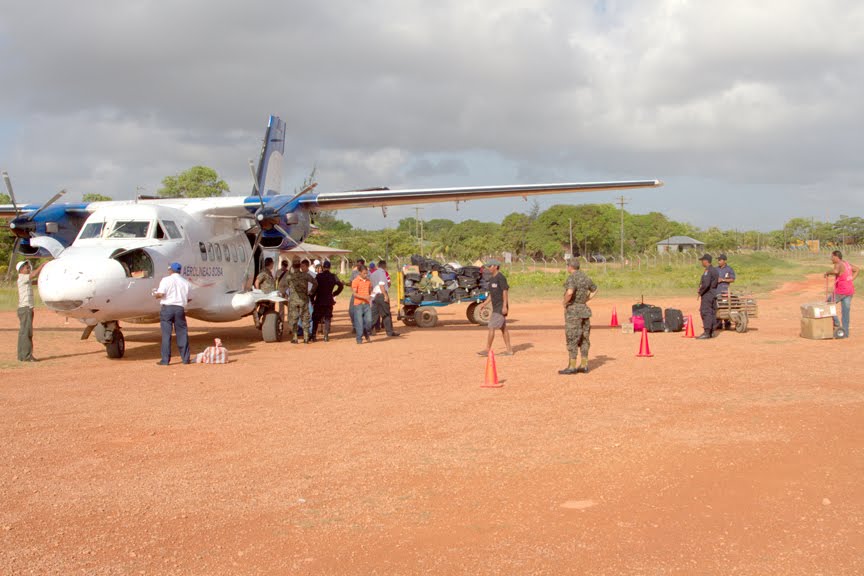
We landed on the smallest airfield I have ever seen. I have seen some small ones, but this was still surprising–like something from the third world. Oh. Wait. Dirt runway. Shacks for the “terminal”. And soldiers to meet us and check our ids—they wanted to make sure we weren’t drug smugglers. You would think they would check the people leaving, not arriving, but it wasn’t a big deal.

We grabbed a taxi to go to our hotel. Imagine my thoughts at this point. No paved roads. The smallest airport in the world. What is the hotel going to be like? I had pretty much resolved that it was going to be basic before we got here, but my imagination was really spinning. Hot water? I was hoping for that.

As we pulled up I was pleasantly surprised to discover a very nice place. We got to choose between air conditioning all day, or from 6 pm to 6 am, or fans. We chose the middle option, although at 4:30 as I write this, there is no electricity anywhere in the building so had we paid for the extended air conditioning, we wouldn’t have it. The court yard outside the rooms gets a very nice ocean breeze making it a very comfortable place to sit.

One of the more amusing things about the place, the only paved road anywhere in Puerto Lempira is 50 feet of pavement in front of our hotel. That’s it. Nowhere else. Elmer said the owner of the hotel used to be the governor of this state. So, I guess he has connections. He also has his own water treatment/bottling company.

Ironically, hot water in the rooms is the only thing it doesn’t have.

Quick addendum: I have now flown back to La Ceiba. The security at the airport leaving was pretty amusing. There were a couple 20-year-olds with M16s standing around, but not much else. We walked across the landing strip to the “terminal” and hung out. Then boarded the plane and left. No one checked our bags or anything. Well, that is until we got back to La Ceiba. I guess the odds on anyone carrying anything dangerous on board the plane are pretty low, but they wanted to make sure we didn’t bring anything into the city. Very funny. Just sit back, close your eyes and trust they know where they are going..

Filed Under: Diving, Documentary, Photography, Travel

Now Available!

Photojournalist Mike Scott is about to get married to the woman he loves — archeologist Frankie DeMarco – but her kidnapping sets Mike on a collision course with the treasure hunter who took her. The man wants Frankie’s help finding a 400-year-old shipwreck so Mike sets out to find it first to get her back […]

View Book

Spooky Flash Fiction For Advent 2025

December 18, 2025 By Eric Douglas

In the 1963 Andy Williams song, “It’s the Most Wonderful Time of the Year,” there is a line that says “There’ll be scary ghost stories, And tales of the glories of Christmases long, long ago.”

Take a flight in a biplane!

https://youtu.be/WN8BrcSNel0
https://youtu.be/lFWWbTXrTJQ?si=SJAadKSt9ZLCbOvX

How I got into diving!

https://youtu.be/gKhw-4tORAM

Heart Blog

Heart Survivor Book Proceeds to Heart Walk

Charleston author Eric Douglas will donate proceeds from his book Heart Survivor: Recovery After Heart Surgery to the 2017 Charleston Heart Walk. Douglas wrote the book to detail his recovery from open-heart surgery and his return to fitness to inspire others facing the same diagnosis. In January 2016, Douglas visited his doctor to rule out the […]

More Posts from this Category

Heart Blog
  • Heart Survivor Book Proceeds to Heart Walk
    Charleston author Eric Douglas will donate proceeds from his book Heart Survivor: Recovery After Heart Surgery to the 2017 Charleston Heart Walk. Douglas wrote the book to detail his recovery from open-heart surgery and his return to fitness to inspire others ...
  • Introduction to the book Heart Survivor
    The following is most of Chapter 2 from the book Heart Survivor. I thought it was important to help my readers understand that I should have recognized the signs and symptoms of impending heart issues, but even with that experience, ...
Read more

Return to Cayman book trailer

Sunlight Prints

Cyanotype printing, also known as Sunlight Prints, is an antique photo printing technique, first used around 1842. Cyanotypes are made by mixing two chemicals (ammonium iron citrate and potassium ferricyanide) and treating paper, cloth or canvas, making it sensitive to ultraviolet light. The sun turns the chemical blue while whatever is shaded stays white. One of the earliest uses for cyanotype was for naturalists to capture images of plants. The same process is used to create “blue prints” of … Read more

The Buzz

You want to explore the ocean, alongside Mike Scott! -- Rosemary E Lunn Diving Journalist and Scuba Industry Fixer
Land Sharks cover
  • Facebook
  • Instagram
  • LinkedIn
  • Substack
  • Threads
  • YouTube

Privacy Policy


NO AI POLICY: Eric Douglas/BooksbyEric does not use artificial intelligence tools to generate, draft, edit, or automate our core work—including writing, artwork or photography. Everything we produce is created by humans.

Copyright © 2026 ·