Books by Eric Douglas

Thriller fiction and Non-fiction

  • Home
  • Mike Scott Thrillers
    • Held Hostage: Search for the Juncal
    • Water Crisis: Day Zero
    • Turks and Chaos: Hostile Waters
    • The 3rd Key: Sharks in the Water
    • Oil and Water: Crash in Curacao
    • Return to Cayman: Paradise Held Hostage
    • Heart of the Maya: Murder for the Gods
    • Wreck of the Huron: Cuban Secrets
    • Guardians’ Keep: Mystery below the Adriatic
    • Flooding Hollywood: Fanatics at the Dam
    • Cayman Cowboys: Reefs Under Pressure
  • Withrow Key
    • Lyin’ Fish
    • Tales from Withrow Key
  • Agent AJ West
  • About the Author
    • Publicity and Interviews
  • Nonfiction
    • For Cheap Lobster
    • Heart Survivor: Recovery After Heart Surgery
    • Oral History
      • Batter Up!
      • Memories of the Valley
      • WV Voices of War / Common Valor
      • Capturing Memories: How to Record Oral Histories
    • Dive-abled: The Leo Morales Story
    • Keep on, Keepin’ On: A Breast Cancer Story
    • WV Voices of War / Common Valor
    • Russia: The New Age
    • Scuba Diving Safety
  • Free Short Fiction
  • Other Fiction
    • Sea Turtle Rescue and Other Stories
    • River Town
You are here: Home / Blog Posts

Taking a creative break

April 29, 2013 By Eric Douglas

The original under glass in the sun.

I love digital photography. Really, I do. You just can’t beat the flexibility you get with digital photography and the ability to edit on the fly saves so much time. I worry about us deleting photos in-camera and losing some of those out-takes, but that’s a conversation for a different time.

There are times, though, when I miss my black and white darkroom. I miss the smell of the fixer and the red light and literally getting lost in the process of printing images. It seemed like I could go in the darkroom in the morning and emerge exhausted eight hours later. Now, I can still spend hours tweaking photographs, but I do it sitting with my computer in my lap and it just isn’t the same.
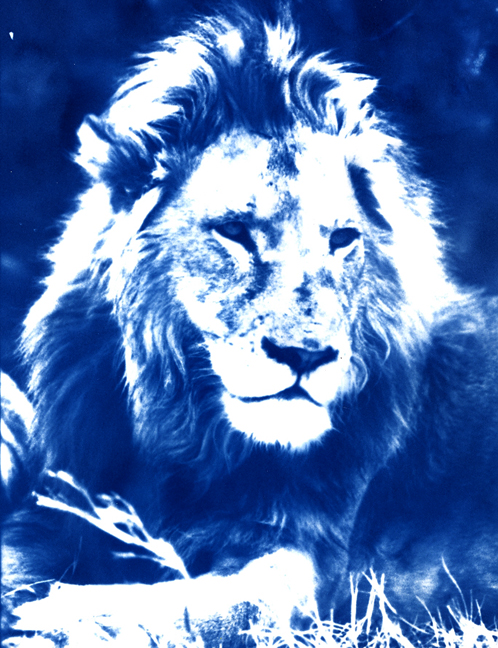
Every once in a while though, I realize I need that creative fix (no pun intended), camera or not. That’s when I go full-on old-school. Cyanotype is called blueprint printing and it’s the oldest non-silver photographic printing technique. And the coolest part, once you’ve prepared the paper, all it takes is sunlight and water. To prepare the paper, you need a solution of potassium ferricyanide and ferric ammonium citrate that you just can’t buy off the shelf, but the concoction is available from specialty photography places.
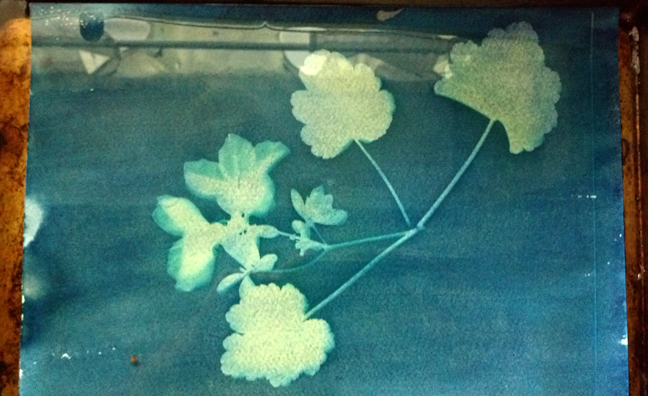
You can use it to make blue prints of photographs by first creating a digital negative, printing it out on acetate and then placing the negative on the paper in the sun. Or, if you don’t want to go to all of that trouble, you can make paper negatives in the cyanotype itself by lying opaque items on the paper and exposing them that way. Whatever the sun touches will end up blue after the wash wherever the sun is blocked will turn white. It’s pretty cool and a great way to take a break from sitting at the computer.
The print developing in a tray of water.

This is often referred to as sun printing. I keep some treated paper around and every once-in-a-while I pull out a few sheets and see what I can find in the yard or the house. Big flowers don’t really work…they end up looking like blobs on the paper. But items with fine details work great. I also like to print with crystals or glass to catch the way the sun reflects onto the paper. The great thing about this process and technique is you can preserve the nature you see around you, capture patterns and discover details you might have never seen before.

That’s probably enough of a break for one day. Time to get back to work.

The final image.

.

Filed Under: Photography

Marshall Memorial and the Green/White Game

April 27, 2013 By Eric Douglas

 IMG_7289
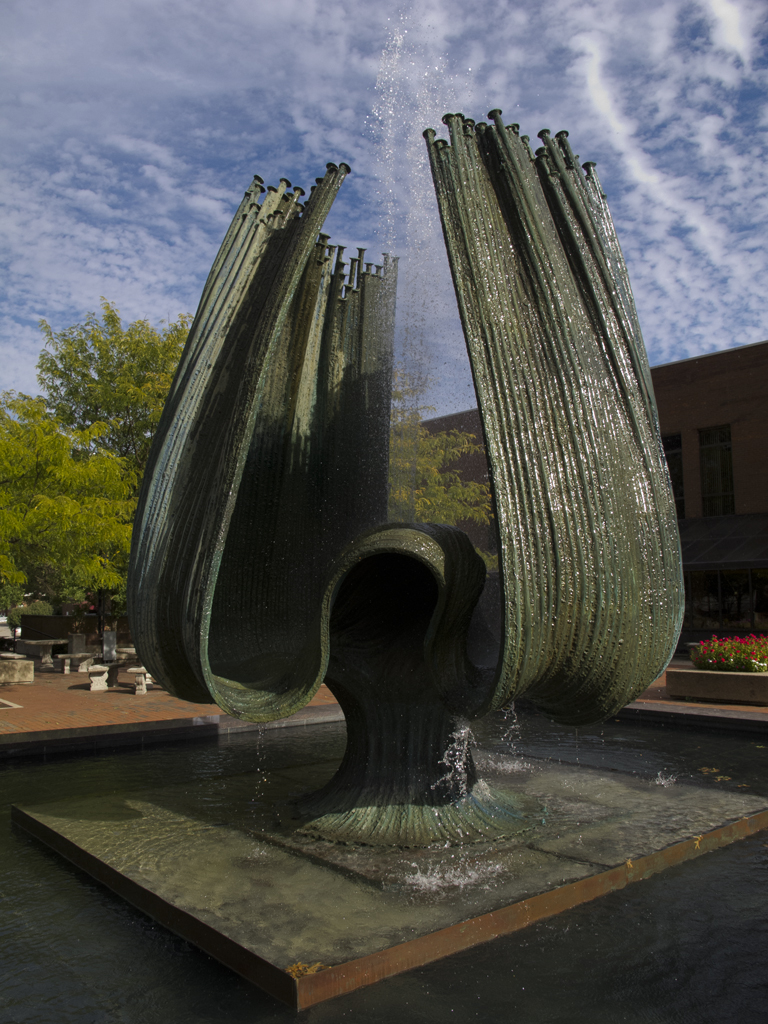
The ceremony on November 14 each year where Marshall University officials turn off the fountain at the Memorial Student Center for the winter is a sort of sad occasion. It is the anniversary of the day a plane crashed in 1970, taking with it a football team, coaches and community members who supported it.

IMG_3061 On the other hand, the day in the spring where they turn the fountain back on is a happy occasion. It is still about remembering the team and those lost, but it symbolizes the team, and the school, triumphing over those dark days. This was just the third year they timed the returning of the fountain with the annual spring Green/White game. Unfortunately, after eloquent speakers talked about the aftermath of the crash and the strength it took to pull the community back together, someone forgot to check the pump that powers the fountain and it failed to flow. I’m sure someone is not having a very good day since this was in front of all those alumni, the Athletic Director and the university president, and it was a bit anticlimactic. The spirit was there, though.

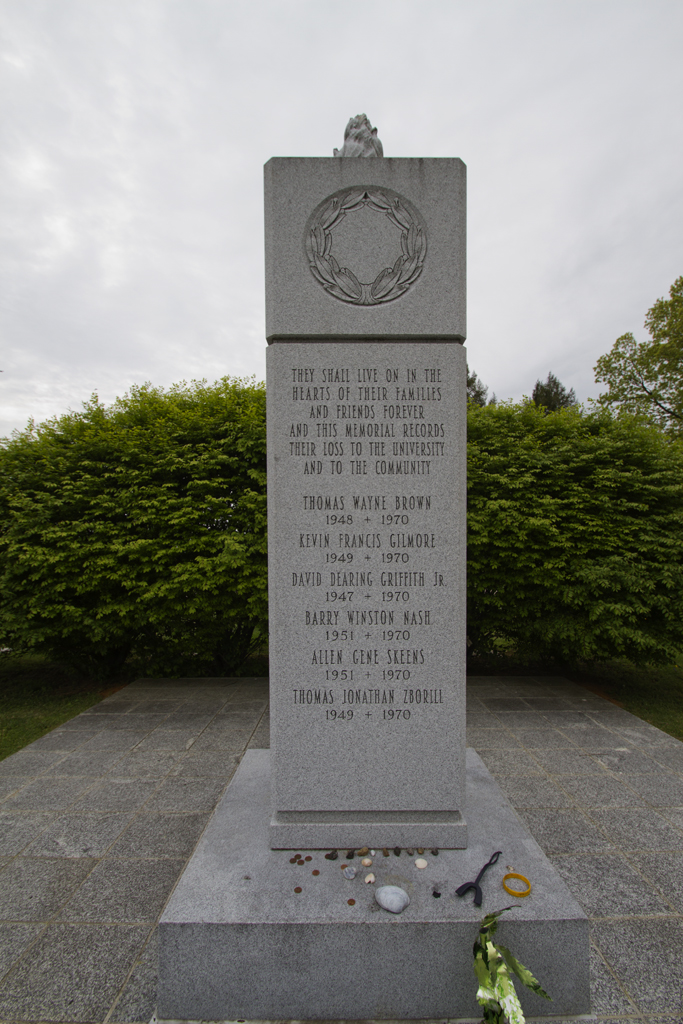
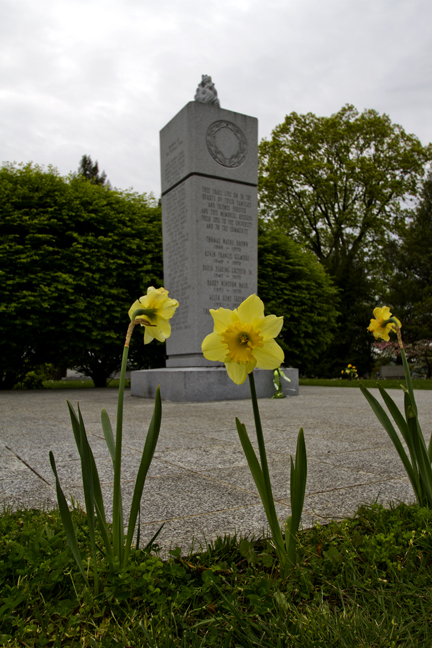
IMG_7326After the Green/White game, IMG_7320we decided to visit the Marshall Memorial at the Spring Hill Cemetery. Neither Beverly nor I had ever been to see it. It is a beautiful location overlooking the city. Six of the players are buried there as their bodies were never identified. As we got out of the car a lady stopped us and asked if we knew why some people left pennies on the graves or on the memorial. Neither of us did, so I looked it up when I got home. I found several answers, but basically “some say to remember the deceased, to let others know that that person has not been forgotten and that people are still visiting, some believe that if you leave a penny the deceased will stay with you and bring you good luck and some say it’s to pay the toll to cross the river.” I could have guessed at each of those.

IMG_7344When Bev and I were in school, in the late 80s, it seemed like no one really talked about the plane crash and everything the school and town went through. I’m sure it was too recent for people to really talk about it. Now, forty years after the fact, maybe the emotions aren’t so raw that everyone can still remember and talk through those memories. It’s good for the school, Huntington and the people to work through that pain and enjoy each other again. Two coaches from the 1970 team were at the ceremony today. One teared up, probably both but I wasn’t close to Red Dawson.

IMG_3060I like this spring event. The green in the trees, the fountain flowing (as soon as they get it fixed) and the green/white game all symbolize the next chapter, a new hopefulness and the possibility of a new year. That is a great thing. After all, football fans are the ultimate optimists. This is going to be our year, right?

Go Herd!

Filed Under: Uncategorized

Walking for the Cure on May 4

April 26, 2013 By Eric Douglas

We just picked up our walk packets.

I learn a lot from my kids. Before I had kids, I always thought it went the other way. I would teach them about this or that. Since becoming a parent, I have learned the truth of the matter. Often, they teach me humility and patience, but that isn’t exactly the lesson I learned this week. Not exactly, anyway. This week my youngest Jami taught me about what’s really important in life.

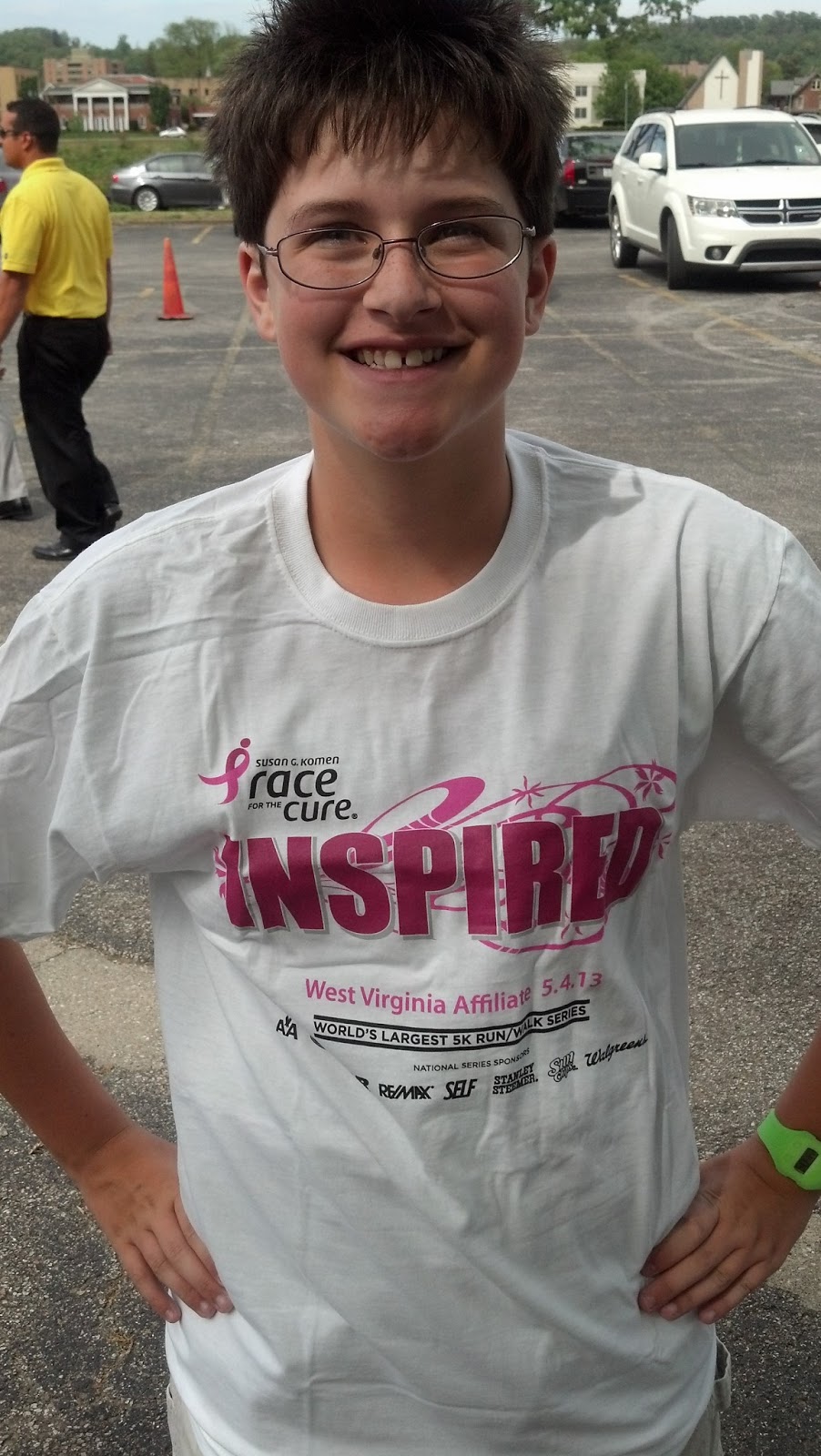
Jami brought home a form from Weberwood Elementary encouraging families and students to join their team and participate in the West Virginia Komen Race for the Cure on May 4 in Charleston. My first instinct was to blow it off, hope she forgot about or say we didn’t have the time. That Saturday is going to be pretty busy. We have a Girl Scout event and a soccer game and…
A few days ago, a girl I knew in high school died after fighting cancer for three and a half years. Throughout her battle, she wanted nothing more than to live and be healthy for her young daughter. She hated how it took over their lives. I hadn’t spoken to Teresa since graduation, although she sent me a nice note when someone sent her a copy of one of my children’s books. Her passing really affected me, though. It made me stop and think about cancer, what it does to families and my other friends who have survived it…and those who haven’t. It also made me stop and think about my two daughters and what it would be like for them to lose a parent.
So I sat down and registered us for the walk. We’ll be walking, not running. Honestly, mowing the grass the other day, I rolled my foot and definitely did some damage. I full-well expect it to hurt. Doesn’t really matter, though, in the grander scheme of things.
If you’re interested in walking, visit the Komen West Virginia page, join a team or set up your own. Get out there and walk. If you can’t be there, there’s even a Sleep In for the Cure option.  You can also make a pledge to support our walk if you want.
Do whatever you want or you can, but it really is time for little girls to stop losing their mommies.

.

Filed Under: Adventure

What Earth Day means to me

April 22, 2013 By Eric Douglas

It seems like everything got green over the weekend. Flowers were out before that, of course, and the grass was growing (I mowed my grass for the first time last Tuesday. Many of my neighbors were on their second cutting and I’m sure they were looking at me wondering why I hadn’t mowed yet, but that’s a different discussion.) Still, this past weekend, it seemed like the earth finally shook off the last vestiges of winter  and spring took hold—my apologies to those of you reading this who live to the north and are still struggling to kick winter to the curb.

Spring comes with a renewed sense of joy and excitement. The birds and the squirrels are chasing each other around the yard; two different bird families are growing on the same ladder leaning against our house, as a matter of fact. We’re calling it the birdie condo as one nest is on the top step and the second is on the third step.


It’s fitting, then, that Earth Day should come lock step after this green-up. While we’ve done a lot to care for the earth in recent decades it seems like we still have a lot of work to do. The river that runs through my hometown is dramatically cleaner than it was when I was a kid. The air is much better, too. I don’t hear anyone talk about the Kanawha crud any more—the coughing/wheezing you got from whatever the chemical plants were burning off into the atmosphere. Those are good things.

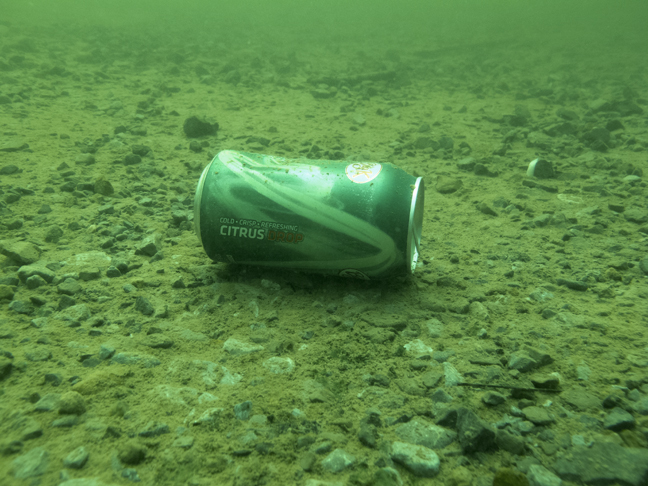
I still vividly recall the commercial from my childhood that featured a Native American standing beside the road, crying at the sight of litter thrown at his feet. While it doesn’t seem to be as bad as it used to be, there is still litter on the ground. You even see it in the “protected” areas and back country trails. That astounds me. As a diver, it really drives me crazy to see litter underwater. This is a perfect example of “Out of Sight, Out of Mind.” If you throw trash overboard from your boat, you never see it again. I wrote about that last year in this blog. And every time the water gets up after a rain, the amount of trash left on the river banks is astounding.

Last weekend, I spent time in the mountains of Pocahontas County, West Virginia with friends. Most of the county is within the Monongahela National Forest. Still there were beer bottles and soda cans on trails that people could only get to by hiking or riding four wheel drive vehicles. We were all frustrated by the sight of the trash. Pack out whatever you pack in. In the diving world, we say, “Take only pictures and leave only bubbles.”

The group Keep America Beautiful that created the Native American commercial is still out there doing good work.

Politically, the “green” movement has always suffered from stigmas. People who wanted to care for the earth were considered radicals and tree huggers. They were placed on the opposite side of most debates from corporations and people who thought environmentalists wanted to take care of trees before people. Today this has boiled down to an argument of “liberal” versus “conservative”. Ironically, many “conservatives” I know are religious people who like to get out in the woods to hunt, fish and enjoy nature. As a Christian, I know it is my responsibility to be a good steward of the planet and I suspect every other major religion in the world says the same thing.


This would seem to be a place where everyone can agree. “Liberals” who want to be green. “Conservatives” who enjoy nature. Christians and people of every faith who want to obey God. I understand that there are different approaches and we all have different ideas on what we should do, I think sometimes we forget to acknowledge that common ground first. After that, everything should be easy. Honestly, if we would take care of the little things, like litter, I think we would have an easier time with the big issues.

I am really inspired by a man I interviewed earlier this year for the Voices of War project. (Major Richard) Ritchie Ojeda is working his tail off and giving his time to clean up Logan County, his home. He is disgusted by the trash and rundown homes. Instead of giving up on it, he is doing something about it and getting those around him motivated to do the same. We should all follow that example.
Taking care of the world around us shouldn’t be an issue of Liberal or Conservative. We all share this world and it is the only one we have.

.

Filed Under: Uncategorized

We are all Chillers!

April 19, 2013 By Eric Douglas

People make movies in Los Angeles. People pen graphic novels in New York. Right?

Nope. Not even close.

The digital/information age has done more than make books, movies and cat videos available at our finger tips. It has leveled the playing field for every creative mind with an idea. You don’t have to be a part of a big film studio or associated with a large publishing house. In fact, it is often to your advantage to be independent.

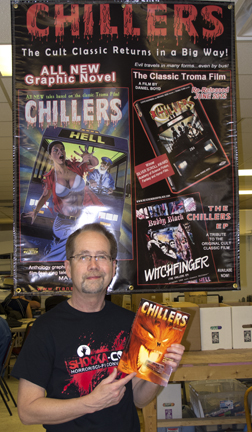
Case in point: Chillers II, the latest graphic novel by Daniel Boyd and his stable of friends, writers and creatives. Just a few years ago, it wouldn’t have been practical to produce a book like this in West Virginia, but last Tuesday night was the official release date for the latest graphic novel in the Chillers series. Every one of the contributors for the project, save one, is from West Virginia. Boyd is an assistant professor of media studies at West Virginia State University. The original film Chillers was Boyd’s first feature film in 1988. It consisted of a series of interconnected short horror stories with a message behind them. Flash forward to present day and Boyd has taken that same idea and moved it to the graphic novel format.

“Our formula is simple: frighten and enlighten. Like Rod Serling taught us with The Twilight Zone, the best stories of the fantastic are those that say something,” Boyd said. You don’t have to look too deep into the stories to find the message inside of them.


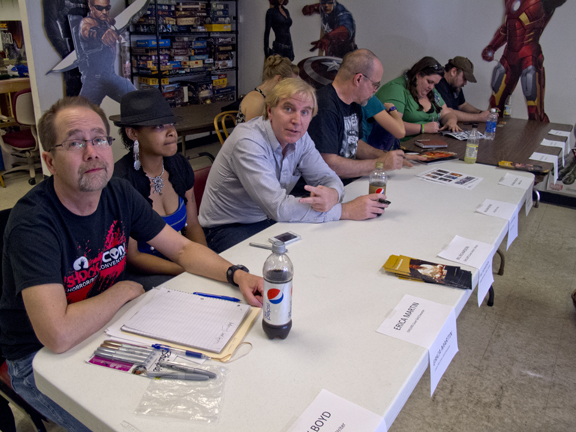
I picked up a copy of the book and had Boyd, along with most of the contributors to the anthology, sign it. I remember going to see the movie and I have enjoyed reading both books now. This is a great series and I really hope it continues for a long run. The stories make you shudder, make you cringe, and make you think at the same time. Every story ends with a character climbing on board the symbolic bus from the movie that takes them to Hell for something they did in the story. Justice is served. 

Danny is an inspiration to me and a lot of others with this project. I love that he mixes established writers in his projects with up and coming writers in the form of his students. He has always done that. When he made Chillers, the movie, much of his talent and crew came from the halls of West Virginia State. Over the years, I have heard so many people tell me they “plan to write a book when they get the time.” Every writer I know rolls his/her eyes when they hear that. You have to make the time or it will never get done. With this project, Danny teaches his students that final lesson. If you want to do something, do it. Make it happen. No one is going to give you permission. You just have to make it happen. Work out the details later.


I think it’s time for me to get to work on my next project. Maybe I’ll write another horror story.
Hold on. I think I heard something down the hall…why is there a bus parked out front?

.

Filed Under: Books

Get outside and get living

April 17, 2013 By Eric Douglas

I wrote this last week, before the awful events on Monday. I think it is doubly important to get outside, breathe some fresh air and enjoy life. You never know when it will be cut short. Tomorrow is not guaranteed.  


Doing some yard work last weekend I realized I’m not 20 anymore. As a writer, my job is mostly sedentary and I told my wife I’ve come to realize I’m not even in particularly good shape for a 45-year-old. Of course, I can always make excuses that this past winter was nasty enough that I couldn’t get outside and do much. That would just be an excuse, though.

I recently read a review of a local restaurant from someone who was just passing through town on their way south. The writer made the point that he didn’t understand why West Virginia has the reputation for being overweight. He said there are Stairmasters everywhere you look. You just have to go outside and climb up a hill.

A good friend and a veteran of two tours as part of Operation Iraqi Freedom, David Dean, told me recently when I interviewed him for the upcoming Voices of War documentary about West Virginia war veterans “What really saved me from that first tour was working on the river as a river guide. It was just peaceful. It let me get out of the war mode and back into a living mode.” 

A week or so ago, a report came out that identified Charleston as the Most Unhappy place in the country to live. “The Gallup-Healthways Well-being Index score is an average of six sub-indexes, which individually examine life evaluation, emotional health, work environment, physical health, healthy behaviors, and access to basic necessities.” The Huntington-Ashland area held this position for the last two years and has moved into the second-most unhappy place. When I commented on this on my blog, Brad Deel replied:

“There are several things Charleston could do to encourage healthier behaviors. There is no reason a person shouldn’t be able to get on a hiking/running/biking path in Charleston and travel up the Elk to Coonskin. Several consultants have suggested changing from 4 lanes to 2 travel lanes with a center turn lane combined with an expanded riverside walkway. Connecting trails with clear marking is another way to make it easier. It’s not just a quality of life issue. Businesses look for things like this when they think of relocating. Creating a vibrant trail system would require creative thinking, a master plan, and solid public/private partnerships but Charleston may be the only capital city in the country without interconnected trails.”

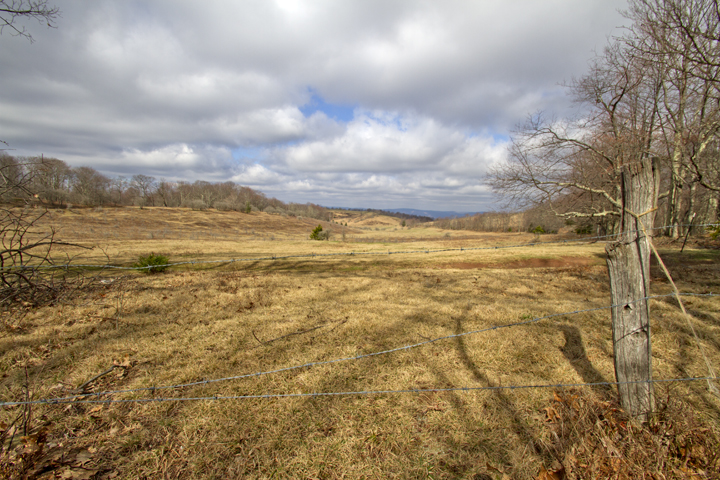
A couple days ago a friend told me he was going fishing this past weekend in Pocahontas County. He said I should come along. At first I demurred with all the standard excuses; too much to do, busy, can’t get away. And then it hit me that I needed to get back to living mode myself. I haven’t done anything as stressful as going to war. Instead, I’ve gotten out of the habit of being outside and being active. I called him back and told him I was coming. It was great to get outside in some fresh air to experience the quiet, see running water and just breathe. If you want to see more photos from the trip, check out the Mountain Time blogfrom earlier this week.

It is time to get on a “West Virginia Stairmaster.” Ready to join me?.

Filed Under: Adventure

  • « Previous Page
  • 1
  • …
  • 54
  • 55
  • 56
  • 57
  • 58
  • …
  • 87
  • Next Page »
Now Available!

Photojournalist Mike Scott is about to get married to the woman he loves — archeologist Frankie DeMarco – but her kidnapping sets Mike on a collision course with the treasure hunter who took her. The man wants Frankie’s help finding a 400-year-old shipwreck so Mike sets out to find it first to get her back […]

View Book

  • Facebook
  • Instagram
  • LinkedIn
  • Substack
  • Threads
  • YouTube
Privacy Policy

Copyright © 2025 ·