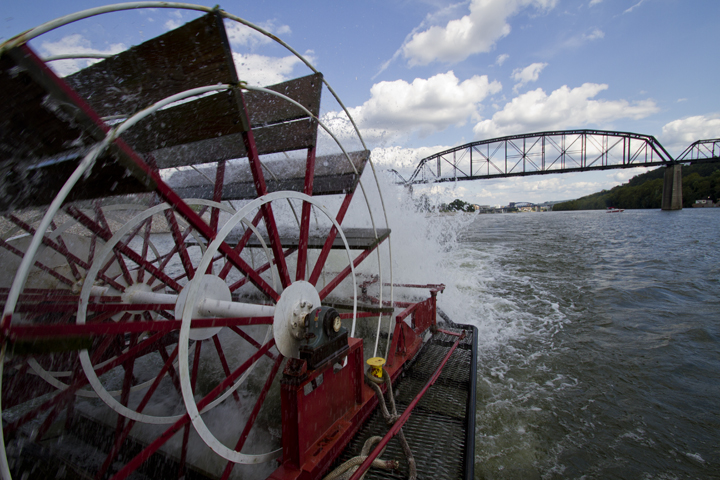
There’s no cooler way to get around on the river than on a sternwheeler.
If you’re looking for power or speed, diesel-powered tug boats and gasoline-powered speed boats make up most of the water traffic around the country; their propellers churning up the water and pushing boats quickly up and down the waterways.
Sternwheelers are different. There’s something reassuring about the wheel rolling along behind you; each paddle (known as buckets on sternwheelers) digging into the water and pushing the boat forward, setting up a calming vibration. It is slow and majestic. When you’re riding on a sternwheeler, you can’t get in a hurry. The pace of life is slow and once onboard you quickly conclude that’s just fine.
It just so happens that the pool between the river locks at Marmet and Winfield, WV on the Kanawha River holds one of the largest (if not THE largest) concentrations of privately-owned sternwheelers in the country. Most of these sternwheelers were built as pleasure craft and have never served as work boats. But what they do, and do very well, is help onlookers recall history and enjoy a sight long-gone from rivers around the country.
One of my earliest memories of the Kanawha River is going downtown to watch the sternwheeler races at the Charleston Sternwheel Regatta held over Labor Day weekend in the late 1970s. We took blankets and sat on the river bank while the boats cruised past; the ones who were trying hard to win were throwing water straight into the air from their quickly-spinning wheels. The rest took a more leisurely pace.
That festival is long gone and most people around town don’t have a clue that sternwheelers once routinely worked this river, pushing coal and timber to grow a burgeoning country while bringing back supplies for West Virginia.
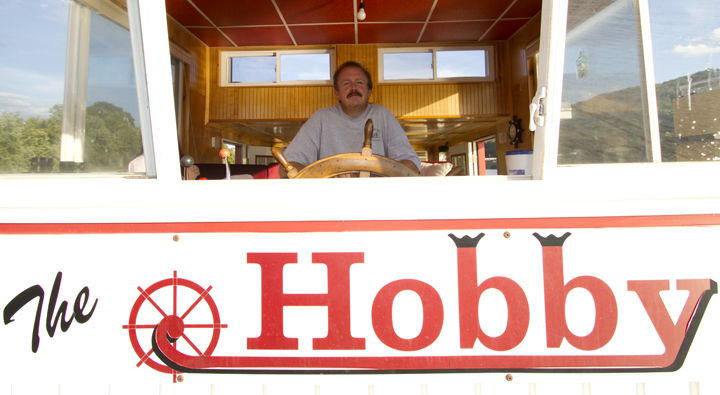 One of my best friends happens to be one of the owners of Hobby III, a sternwheeler that makes its home in Nitro, WV (although they claim their home port is the Port of Indecision, giving a nod to Jimmy Buffett). Whenever JD Pauley says he is taking the boat out for a day, I do my best to clear my schedule and go along.
Most of the sternwheelers on the Kanawha, like Hobby III, are personal missions for their owners. Boats are notorious for being holes in the water to throw money into and sternwheelers are probably even more so. Most of them are fabricated from whatever the builders have lying around. There aren’t standardized parts available for them and you can’t go down to the sternwheeler dealership and buy one.
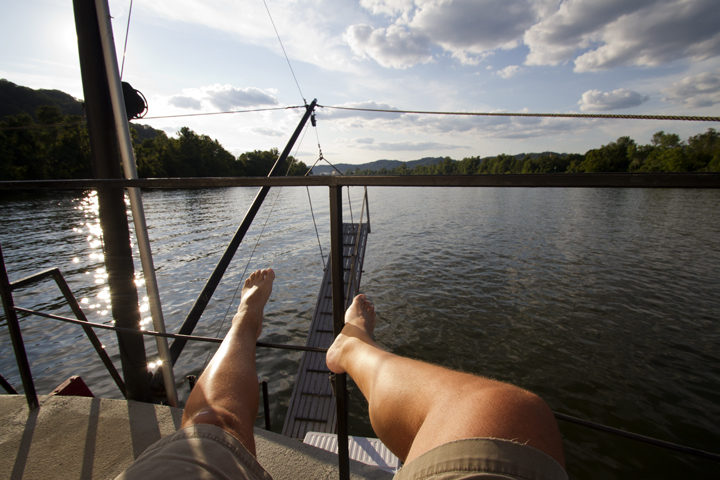
The next time you see a sternwheeler rolling down the river, slowly making its way, give it a wave or a honk to say thank you. The people on board aren’t re-enactors dressed in period costumes pretending to be someone from the early 1900s. They’re just people who enjoy the river and want to take life a bit slower. At the same time, they’re keeping history alive to remind the rest of us what built this country and state. I think they know that, too.
Below is an essay I wrote fifteen years ago about a trip I took on the Hobby III from Charleston to Marietta, OH. It took us three days. With a couple minor tweaks, the following is exactly how it was printed that year.
Three Days to Marietta
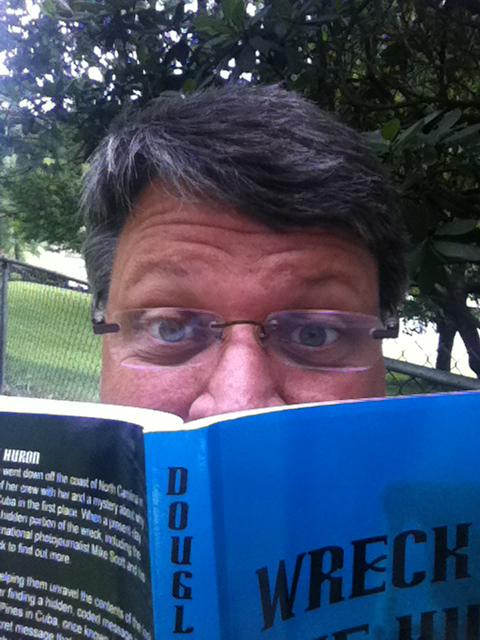
By Eric Douglas
The smoke from the fireworks had barely blown away when we left Charleston. The Regatta was over. If it weren’t for the good times that follow the sternwheelers and their owners, there would be very little to tell about that event. Once proud, politics have reduced the Charleston Sternwheel Regatta to a shell of its former self.
The fireworks were good at least, the boaters all said. The only other positive comments to be heard all began with “This USED to be the best festival…..”
Once we got outside of Charleston headed down the Kanawha, the river was like obsidian. Dark and shiny, it rippled and waved but never broke until we passed. The wind had died down to almost nothing. Leaving the larger cities along the Kanawha, the lights on the banks diminished quickly. To put a little more river behind us and get a jump start on the morning, we were making a midnight run but about 3 a.m. the long nights and the sunny days were catching up to everyone on board so we tied up and slept.
We were an interesting group on this trip. First off, there were two sternwheelers: Lakie Marie and Hobby III. We were rafted together in Charleston after the races on Sunday and didn’t untie for the next three days. On board Lakie Marie were Bill, one of that boat’s owners, and his sister Betty known on the river as Mom and a first-class cook. On Hobby III were long-time pilot and new owner J.D., new owner Denny, Denny’s mother Phyllis and sister Melanie and I.
We were well on our way to Marietta if only about 15 miles down the river. We were well on our way because everyone was in the river trip mind set. Almost no one thought about getting off for anything. J.D. had to leave us even though I think it nearly killed him. We were still within a 30 minute drive from our homes and could have very easily made a phone call and had someone come and get us if need be, but I don’t think that idea ever crossed anyone else’s mind. We were on our way to Marietta for a festival known among Sternwheelers as a place where they take care of boaters.
You have to understand that this trip was special. J.D. and Denny just bought Hobby III a month and a half before. While they have spent all of their time on the boat, this would be the first long trip they would make on it.
Hobby III has an interesting history. The late Captain Harry Wilson began building the boat in 1977 and finally put it into service in 1985. He named it Hobby III. Old timers on the Ohio River have numerous stories about Harry and his adventures or misadventures on the river. Harry died at the wheel on a trip in 1992. Considering some of the new adventures, or misadventures, Hobby III and her crew get into it is often said that Harry is still on the boat. But no one gets hurt and everyone has a lot of fun so it is also believed that Harry watches out for Hobby III.
After his death, Harry’s wife Louise sold the boat to Brian Honaker and Brian moved the boat to the Kanawha River. J.D. had served as the pilot on Hobby III almost from the time Brian bought the boat. And he fell in love with it. When the opportunity arose, he and Denny bought the boat and immediately began to make it their own. The river and especially sternwheelers have a pull that is hard to explain.
Sternwheeler owners don’t spend all of their time and money on their boats for festivals and races in once-proud river towns. Sternwheelers and their captains love the river and the majestic boats that travel it. There is a mystique, a mystery and an aura of intrigue that surrounds Sternwheelers. It has to do with the assumed nobility of an earlier age no doubt. Sternwheelers represent gentility, nobility and respect.
Don’t get me wrong, sternwheeler owners like to party. At the various festivals, most owners have a wild time till it is way past the bedtime of any but the latest night owls but if it were just about having a place to party with friends, a newer house boat would surely be more convenient and practical. Not to mention, faster.
We began the trip again early in the morning. Bill was up and moving at no more than a few minutes after six after having gone to bed at 3 a.m. With the help of Denny and Bill’s son Mark who joined us for the day, we were soon untied and chugging down the river.
While the river may be beautiful and refreshing and convenient and exciting, it can also be cranky. Not the violent of floods but the cranky of fog. We had fog. It wasn’t bad enough to stop moving entirely but it would have stopped less determined souls. At about half speed, which for the sternwheelers meant about 2.5 to 3 miles an hour, were rolled down the river watching for debris and keeping the boats off of the bank.
Owing much to what I imagine was a devious streak more so than safety, Denny would occasionally blow Hobby III’s air horns. A few times people were outside and waved to us. Many more times, I am certain, people cursed from inside their homes.
After a few hours of traveling, we reached the Winfield Locks and Dam. With very little delay, we were able to lock through and join the river on the next lower pool. Winfield was the first of three locks we would pass through. It is also the smallest although not for long. Very soon, the construction of two new lock chambers will be completed and even the largest of the Tows on the river will be able to pass through.
After the Winfield Locks, there isn’t much to see along the Kanawha River until Pt. Pleasant. Not that that is necessarily a bad thing. We still had several hours on the Kanawha until we reached the mouth. There is something to be said for traveling along portions of the river that must closely resemble the river first seen by explorers when they crossed the Appalachian Mountains or by the flat bottom river boats that first plied their trade on the Kanawha or even by the working Sternwheelers of the 1920s and 1930s that brought the coal and first salt and then chemicals out of West Virginia and delivered it to points throughout the United States.
That portion of the river is quiet and leads those who travel it to be reflective. You start to wonder about things like the boats and men that worked this river 100 years before. An then you get waked. Not awakened, although that is likely to happen too, but waked, as in what happens to you as a cabin cruiser rushes past and the wake off of his hull rolls across your bow.
It happened to us, not far from Pt. Pleasant. We saw him from a long way off. Thirty feet of plastic cabin cruiser, rolling up the river pushing water all around. He passed by no more than 30 feet distant and three waves crashed over our bow. Fortunately, not a lot of river water made it into the cabin.
There is a real feeling among Sternwheeler owners that people in plastic boats need to learn a few things about courtesy on the river. It is a somewhat unfortunate fact that you don’t have to know anything about the river to buy a boat. Just have the money. Maybe because they have nothing else to do, most of the plastic boats seem to continually fly. But do they ever stop and think about the river? I doubt it. If nothing else, riding on a Sternwheeler teaches you to slow down. No matter how anxious you are to get to where you are headed, there is no point in getting in a hurry. When you slow down, you have time to think and appreciate the river more.
Approaching the Ohio River at Pt. Pleasant, things begin to change. The final 30 miles of the Kanawha is less mountainous and surrounded by farming bottom land. It is a wonder that the land is still as productive as it once was. Most of that river bottom land was once subject to regular floods that brought with it fresh new silt that created rich growing conditions. The taming of the river, while still not complete thank God, has done a lot for improving boating but has stopped a natural process of renewal.
Then we turned north. The Kanawha River took most of Monday, Day One but we continued to cruise up the Ohio. We finally came to a stop at the home port of the third boat that was to be our traveling companion for the trip up the Ohio, the Cheryl Lynn II owned by John Thomas.
Cheryl Lynn II spends most of her time within sight of Pomeroy, Ohio on the West Virginia side of the river. When we arrived at the river camp we off loaded two passengers and picked up two more along with a boat and her captain. When we docked to Cheryl Lynn II we tied off and once again didn’t untie again.
Bill and his son Mark had to take care of other business on shore but Gary, the other owner of Lakie Marie and Carol joined us for the remainder of the cruise.
At the close of that evening, we got to see a sight that put it all in perspective for us; the Delta Queen. The Delta Queen is one of the Three Queens, three sternwheelers that cruise the waters of the Mississippi harking back to the days of old. The Delta Queen is a steam-powered sternwheeler.
I was the only one on Hobby III at the time so as she steamed past, I pulled on the horns and whistles. The Captain of the Delta Queen returned the honor by sounding his steam whistles.
The next morning, we awoke to fog. The fog on the Kanawha had been bad but this was worse. It was too bad to even bother to untie. It was so thick you couldn’t see a boat dock 50 feet away. We didn’t leave the dock until 10 a.m. That put us behind schedule.
We were also a little concerned. We had never traveled with Cheryl Lynn II before. John had recently had to replace sections of his drive train and didn’t want to push his boat very hard. As it turned out, there was nothing to worry about. The three boats ran together well and we averaged better than 5 miles and hour up the river.
After a few hours on the river, we came to the Racine Locks and Dam. Our first locks on the Ohio. At least it was the first one for Denny and Myself. Both John and Gary had been through Racine several times. They both said many times that, because of the size of the lock chambers, you never have to wait on the Ohio. It took us better than 2 hours to get through Racine. The small lock chamber was down.
For the uninitiated, I think I need to explain locks and dams. In the mid-1800, prior to heavy river traffic, the rivers of this young nation were subject to tremendous fluctuations of water depth that would make them very difficult to travel. In the summer, you could walk across the Ohio and even in the deep places, downed trees caused snags that would catch the smaller packet boats.
To make the rivers navigable year round a system of locks and dams were built on major waterways throughout the United States at the turn of the last century. These locks and dams raise the pool of the river to a consistent level to allow heavy barge traffic to progress up and down the river. The locks are chambers that allow boats to float up or down to the next pool of water.
In the 1930’s the system of many small locks were replaced with a few much larger locks and the sizes of the boats and barges grew accordingly. It wasn’t too much longer that Sternwheelers grew into disuse. Larger diesel powered tow boats with propellers were stronger, faster and more maneuverable.
In the 1970s, the Corps of Engineers, the government organization that maintains the nation’s waterways, began upgrading the size of the lock chambers. Many of the locks and dams only had 600 foot long chambers. Packs of barges had to be broken down and sent through the chamber a few at a time. This took time. Now, all of the locks and dams in the immediate area have been, or soon will be, upgraded with newer lock chambers that are 1200 feet longer or more. The construction at the Winfield Locks and Dam is nearly finished and should be opened anytime in the next month.
Still, even with all of these improvements to transportation, one of the chambers was closed for repairs when we made it to Racine Locks and Dam. There was already one tow boat with a full barge pack waiting and we arrived at the same time as a second tow with a full pack of barges.
After some long radio discussions, we were allowed to lock through with the first tow boat. The boat was the Omega. He had nine jumbo covered barges, three deep and three across, filled with Aluminite. He explained to the Lockmaster it was the powdered form of Aluminum and not explosive. In total, the boat and barge pack was 960 feet long and filled the chamber from side to side.
Our biggest concern, and that of the Lockmaster, was that when Omega fired up her engines to push the barges out of the chamber, we would be swamped. The captain of the Omega promised it would not be a problem and true to his word, he pushed out of the lock chamber with barely a ripple in the water. We stayed put until he cleared the chamber, however.
It is sort of amazing to realize that the Omega was 960 feet long so we still had nearly 300 feet of chamber space left. At our longest point, Cheryl Lynn II and her party barge, we were only about 80 feet long.
The only problem we had with that lockage was being over cautious about space and not realizing which way the chamber doors swung shut. We tied off on the back floating pin with our stern line thinking this would give us as much room between the Omega and ourselves.
Then doubt hit. Are we far enough away from the gates? Will they hit the wheels when they close? So we untied and tried to move up to the next floating pin which was about 20 feet further in. You have to understand, sternwheelers are not the most maneuverable vessels on the river. Even the three boats ties together with their ability to act independently are not as responsive as newer towboats.
We started floating and got away from the wall. At that point we decided to back up and return to the pin we were on at first. As soon as we did that and got tied down, everything went smoothly.
The rest of the day on the Ohio went smoothly and uneventfully. We all relaxed and chugged up the river. Occasionally blowing the horns for people standing on the shore or in boats and generally just enjoying the day.
About 8 p.m. we approached the final lock and dam on the Ohio River between us and Marietta. It was the Belleville Locks and Dam. Imagine the difference in this lockage and the first one. We were in the smaller chamber, which is still around 900 feet long, by ourselves. So what did we do? We still tied off on the first pin we came to just like at Racine.
For whatever the reason, there was a lot of trash in the water at Belleville. It made us all very nervous for a few miles watching for big logs and other floating debris in the water that could very easily break a spinning wheel. Needless to say we didn’t make very good time. At around 10 p.m. we finally pulled into our planned destination for the night. Hockingport. At the mouth of the Little Hocking River.
Gary and John on Lakie Marie and Cheryl Lynn II had stopped there the year before and everything had been fine. Things were a little different this year, however. The docks had changed and expanded and there was no one around.
We pulled up to the main open dock at first but quickly Hobby III’s bow was in the silt. After looking around and debating for a while, we finally decided to back out and pull into a fuel dock about 50 feet away. Once that little feat of maneuvering and docking was accomplished, a few people showed up and sold us ice and shore power for the night. All in all it turned out to be a good place to dock but we were all a little skeptical when we went to bed that night.
During the night a cold front moved through, bringing with it a thunderstorm. When day broke, the air was clear but it was cold and windy. We started out immediately. Immediately after fixing a couple pots of coffee on shore power, that is.
The only real adventure we had that next morning was docking in Marietta. The wind continued to blow from at around 20 miles an hour the rest of the way up the river making controlling the three sternwheelers a bit more of a chore than it had been for the last two days.
By around 2 p.m. we came into sight of Marietta. The sky was blue and only an occasional cloud filtered by. At least 20 sternwheelers were already along the river bank and the city’s levee.
That is what made docking a little hairy. Turning across high winds to dock was like raising a sail and daring it to push us. We hoped to dock on one end or the other so the landing wouldn’t have to be as precise but that wasn’t to be the case. There was a space between the boats big enough for our three to dock but that was about it.
So we turned across the river. Just about the time that our position was critical, the wind died down for a few moments and we made a perfect landing. Harry was watching out for us. Within 15 minutes of docking, people were coming by to tell us how good Hobby III looked and tell us stories about Harry. He was with us all the time.