Books by Eric Douglas

Thriller fiction and Non-fiction

  • Home
  • Mike Scott Thrillers
    • Explosion: Down Below
    • Held Hostage: Search for the Juncal
    • Water Crisis: Day Zero
    • Turks and Chaos: Hostile Waters
    • The 3rd Key: Sharks in the Water
    • Oil and Water: Crash in Curacao
    • Return to Cayman: Paradise Held Hostage
    • Heart of the Maya: Murder for the Gods
    • Wreck of the Huron: Cuban Secrets
    • Guardians’ Keep: Mystery below the Adriatic
    • Flooding Hollywood: Fanatics at the Dam
    • Cayman Cowboys: Reefs Under Pressure
  • Withrow Key
    • Lyin’ Fish
    • Tales from Withrow Key
  • Agent AJ West
  • About the Author
    • Publicity and Interviews
  • Nonfiction
    • For Cheap Lobster
    • Heart Survivor: Recovery After Heart Surgery
    • Oral History
      • Batter Up!
      • Memories of the Valley
      • WV Voices of War / Common Valor
      • Capturing Memories: How to Record Oral Histories
    • Dive-abled: The Leo Morales Story
    • Keep on, Keepin’ On: A Breast Cancer Story
    • WV Voices of War / Common Valor
    • Russia: The New Age
    • Scuba Diving Safety
  • Free Short Fiction
  • Other Fiction
    • Sea Turtle Rescue and Other Stories
    • River Town
You are here: Home / Diving / Full Circle

Full Circle

June 1, 2011 By Eric Douglas

The sights, sounds and smells of a place like this come back quickly when you step outside. The semi-controlled chaos on the streets, the brush fires set to clear away growth from the fields, the odd combinations of English and Spanish on the road signs and streets. The heat and the ever-present humidity. But there is also optimism and an energy that is hard to beat.
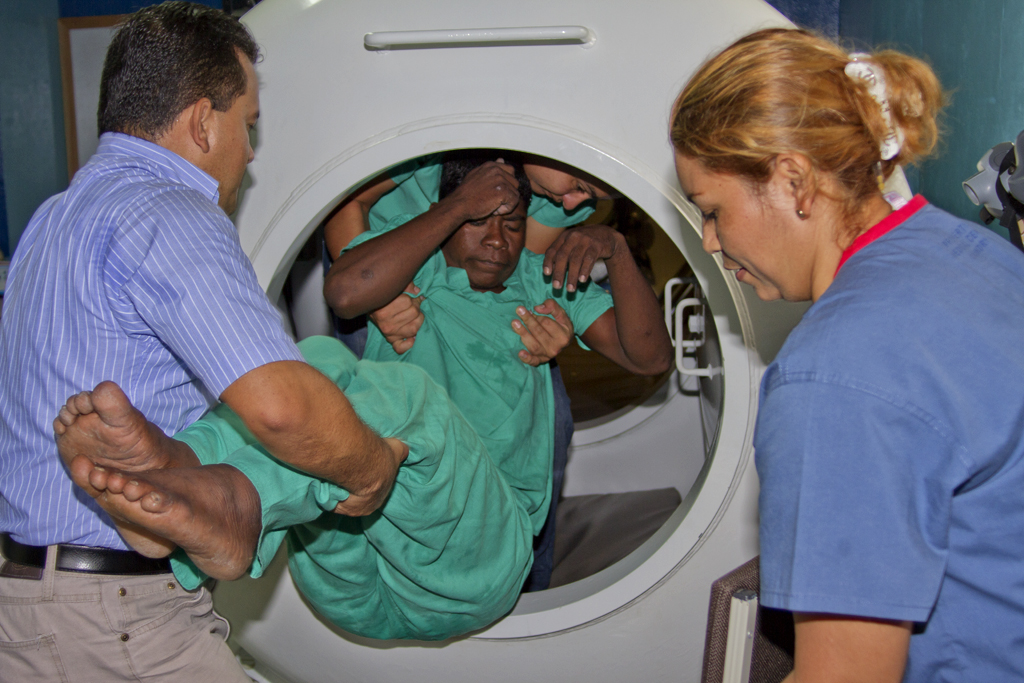
It was a little more than a year ago when Dr. Matias Nochetto and I joined Dr. Elmer Mejia in La Ceiba, Honduras to see what we could do to help out the hyperbaric chamber here and, in turn, help out the Miskito Indians who harvest lobster.

On that visit, we learned how dire the situation was: more than 2000 men were disabled because of diving, and hundreds more joined them every year. And those were the men who lived through their injuries. Many others didn’t.

Now I’m back in La Ceiba. Dr. Mejia invited me down to help him put on three days of training in Oxygen First Aid and additional measures for the boat captains and owners. These are the men who care for (and are responsible for) the divers. This problem isn’t new and there isn’t an easy solution. If you shut down the diving—like has been proposed and the government has attempted to do—the men have no way to make a living and no way to support their families. Their only other option is smuggling drugs. But if something isn’t done, more men will die.

This scheduled training is a great first step. The boat owners realize they have to do something. They have to be more responsible. And they have to take better care of their divers. If they don’t , the government is prepared to shut them down for good. And then everyone loses.

So, I was thrilled to hear from Dr. Mejia when I arrived that he had been invited to speak to the Honduran National Congress in Tegucigalpa today and give his recommendations on how the divers can reduce their risk and how we can improve their care. That is a tremendous first step and a great recognition of the work Dr. Mejia has done. He has not been alone in this. Many others have pursued this project over the years. Groups have conducted training for the divers, lobbied the government and provided health care opportunities. The changes we are seeing (I say very hopefully) are the culmination of many different people working for many years to improve things for these men who harvest the sea.

The next few days should be interesting as we are going to attend a symposium tomorrow where various groups will be taking up these exact same questions. And then the training begins the next day. It should be an interesting week.
Hopefully this won’t just be a circle, but an upward spiral.

For more background:
  • Alert Diver
  • National Geographic NatGeo Newswatch
  • Video documentary “For Cheap Lobster”

.

Filed Under: Diving, Documentary, Photography, Travel

Now Available!

Photojournalist Mike Scott is about to get married to the woman he loves — archeologist Frankie DeMarco – but her kidnapping sets Mike on a collision course with the treasure hunter who took her. The man wants Frankie’s help finding a 400-year-old shipwreck so Mike sets out to find it first to get her back […]

View Book

Spooky Flash Fiction For Advent 2025

December 18, 2025 By Eric Douglas

In the 1963 Andy Williams song, “It’s the Most Wonderful Time of the Year,” there is a line that says “There’ll be scary ghost stories, And tales of the glories of Christmases long, long ago.”

Take a flight in a biplane!

https://youtu.be/WN8BrcSNel0
https://youtu.be/lFWWbTXrTJQ?si=SJAadKSt9ZLCbOvX

How I got into diving!

https://youtu.be/gKhw-4tORAM

Heart Blog

Heart Survivor Book Proceeds to Heart Walk

Charleston author Eric Douglas will donate proceeds from his book Heart Survivor: Recovery After Heart Surgery to the 2017 Charleston Heart Walk. Douglas wrote the book to detail his recovery from open-heart surgery and his return to fitness to inspire others facing the same diagnosis. In January 2016, Douglas visited his doctor to rule out the […]

More Posts from this Category

Heart Blog
  • Heart Survivor Book Proceeds to Heart Walk
    Charleston author Eric Douglas will donate proceeds from his book Heart Survivor: Recovery After Heart Surgery to the 2017 Charleston Heart Walk. Douglas wrote the book to detail his recovery from open-heart surgery and his return to fitness to inspire others ...
  • Introduction to the book Heart Survivor
    The following is most of Chapter 2 from the book Heart Survivor. I thought it was important to help my readers understand that I should have recognized the signs and symptoms of impending heart issues, but even with that experience, ...
Read more

Return to Cayman book trailer

Sunlight Prints

Cyanotype printing, also known as Sunlight Prints, is an antique photo printing technique, first used around 1842. Cyanotypes are made by mixing two chemicals (ammonium iron citrate and potassium ferricyanide) and treating paper, cloth or canvas, making it sensitive to ultraviolet light. The sun turns the chemical blue while whatever is shaded stays white. One of the earliest uses for cyanotype was for naturalists to capture images of plants. The same process is used to create “blue prints” of … Read more

The Buzz

You want to explore the ocean, alongside Mike Scott! -- Rosemary E Lunn Diving Journalist and Scuba Industry Fixer
Land Sharks cover
  • Facebook
  • Instagram
  • LinkedIn
  • Substack
  • Threads
  • YouTube

Privacy Policy


NO AI POLICY: Eric Douglas/BooksbyEric does not use artificial intelligence tools to generate, draft, edit, or automate our core work—including writing, artwork or photography. Everything we produce is created by humans.

Copyright © 2026 ·